
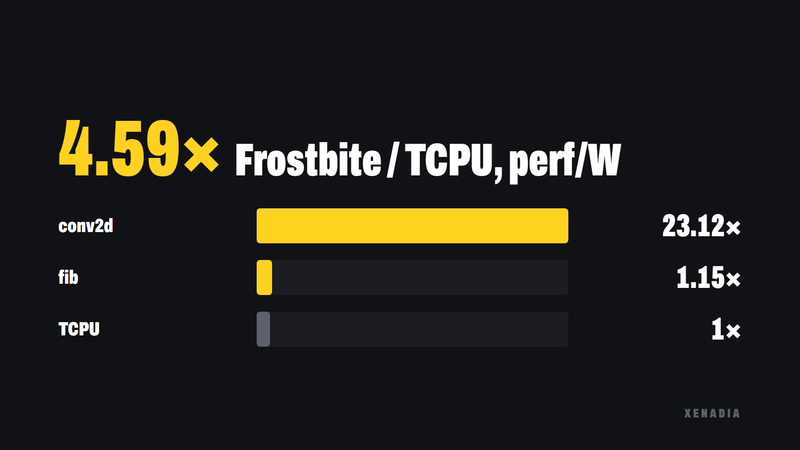
Architect Labs says AI agents designed Frostbite, a CPU with 4.59 times the performance per watt of a small in-order core
The figures come from a 7 nm design that hasn't been made in silicon, measured against a core the startup won't name. On the 15 workloads its agents never tuned for, the lead is 3.83 times.
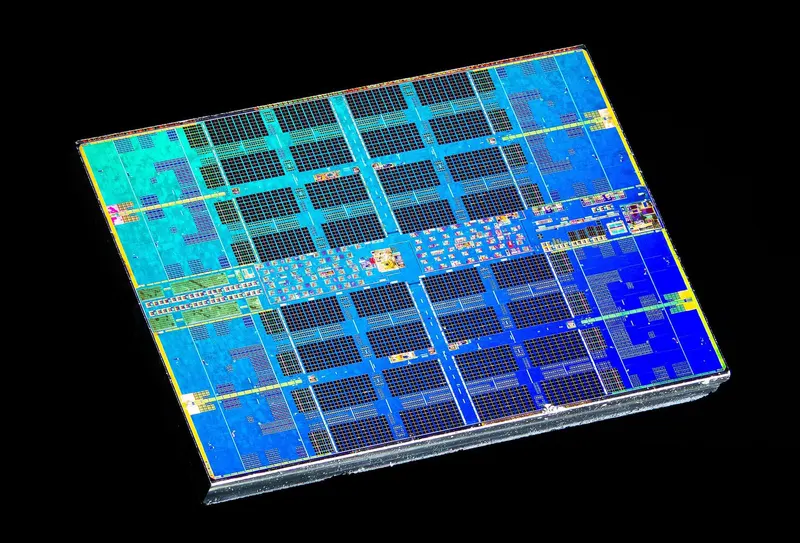
Fritzchens Fritz, CC0, Wikimedia Commons
Architect Labs, a chip startup in Palo Alto, says its AI systems designed Frostbite, a general-purpose CPU with a new instruction set, working through the compiler, the microarchitecture, the RTL (the chip's logic in code) and verification to a finished layout. Across 25 workloads, a block of Frostbite tiles does 4.59 times the work per watt of "a modern, silicon-proven superscalar (dual-issue, in-order) CPU core" of similar size, the company says. It announced the design on November 18. No Frostbite chip has been made, and every figure comes from the company's own simulations of a 7 nm layout: "These are, of course, still pre-silicon power numbers."
Frostbite runs programs as interaction nets, a model of computation Yves Lafont described in 1990. A program is a graph, and running it means rewriting pairs of connected nodes; each rewrite touches only a small part of the graph and no two can get in each other's way, so they can happen in any order or all at once. That lets the chip spread work over many small tiles with no threads, locks or out-of-order machinery, and keep data in small memories next to the logic that uses it. Programs are written in Vine, a language with Rust-like syntax. A tile with nothing to do takes work from a neighbour, or goes idle to save power. "This behavior was never specified by any human," the company says.
Against an unnamed core
The test sets one Frostbite quad, a two-by-two block of tiles with four L3 nodes, 0.792 mm² in all, against one 0.895 mm² core of the comparison CPU, which the company calls TCPU, on the same process. "For legal reasons, we cannot disclose the exact CPU," the company says. The design reached 800 MHz in early synthesis and 500 MHz in the finished layout. On the 10 workloads the agents tuned against, Frostbite averages 6.02 times the performance per watt; on the 15 held back for the final test, five of them added late, it averages 3.83 times. Results run from 23.12 times on conv2d, a convolution, down to 1.15 times on recursive Fibonacci. The company gives no absolute figures for power or speed.
People still set the work: the team picked the five kinds of workload (parallel, staged, sequential, branching and recursive) and which ones to hold back. The post doesn't say which AI models did the design, how long it took or how many engineers were involved. It says swarms of agents tried 58 ideas and kept 37, and that the chip is specified in an in-house language that becomes more than 800,000 lines of Lean, used to prove parts of the design correct.
Doubts, and what comes next
On Hacker News, where the post passed 600 points, commenters questioned the choice of a dual-issue in-order core as the yardstick, far smaller than the out-of-order cores in laptops and servers, and the small size of the test programs; some pointed to earlier dataflow designs such as WaveScalar. The company says it will compare Frostbite with multi-core setups and larger out-of-order CPUs on SPEC and PARSEC "in the coming months." It also plans an online playground running on FPGAs where anyone can try a program, a first operating system, and a release of the RTL and instruction set. It has given no dates and no plan for making the chip.
Architect Labs came out of stealth in June with a $24 million seed round led by Kindred Ventures; its founders are Ebrahim Hussain, the chief executive, and Aaditya Subedi. In August it showed Redwood, an AI accelerator it says its AI built in under two weeks from a specification two people wrote, which so far runs only on an FPGA. Vine is made by Tendrils Compute of Cambridge, UK, which raised $30 million this month for a processor it says will have thousands of cores working in parallel.
Sources
- Architect Labs: Introducing Frostbite (November 18, 2026)architectlabs.com
- Tom's Hardware: AI agents design an entirely new CPU architecture from scratch, startup claims (November 22, 2026)tomshardware.com
- Architect Labs: seed announcement (June 18, 2026)architectlabs.com
- Architect Labs: Redwood (August 27, 2026)architectlabs.com
- SiliconANGLE: Architect Labs nabs $24M (June 18, 2026)siliconangle.com
- Tendrils: $30M raised (November 10, 2026)tendrils.co
- Hacker News: Frostbite discussionnews.ycombinator.com