
KOSPI falls another 3.3% to 4,708, a ten-month low, as the AI chip sell-off deepens and Seoul readies a stabilisation fund
Seoul's main index fell as much as 5.8% before closing at its lowest in ten months, 48% below its June record. Taiwan bounced the same day.
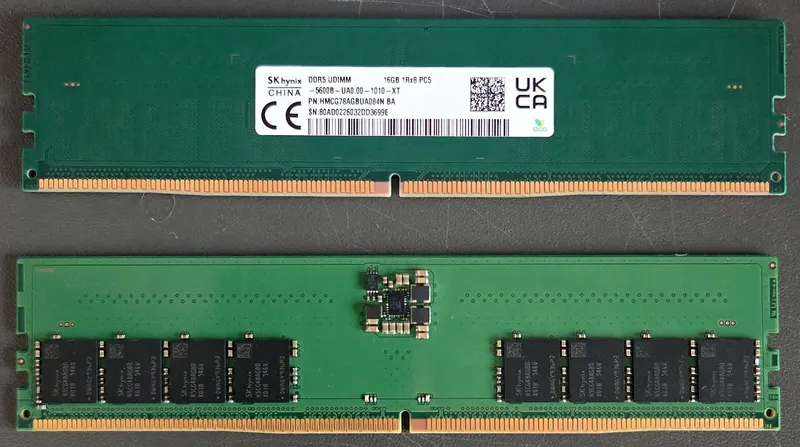
ITEagle Europe - Sebastiaan Broekhoven, CC BY-SA 4.0, Wikimedia Commons
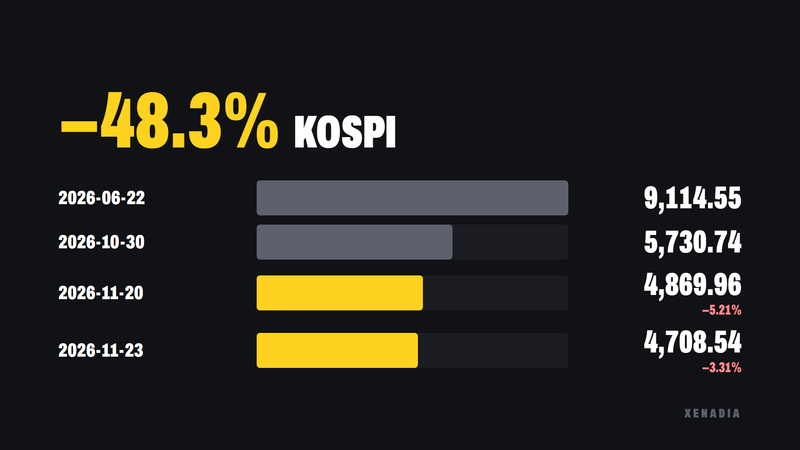
South Korea's KOSPI closed down 3.31% at 4,708.54 on Monday, November 23, its lowest close in ten months, after Friday's tech sell-off on Wall Street hit Seoul's chip makers again. At its lowest the index was down 5.8% at 4,586.80. It now sits 48% below its record close of 9,114.55 on June 22, and has lost almost 18% in November alone.
The fall was steep enough that the Korea Exchange halted program selling for five minutes from 11:33 a.m., after KOSPI 200 futures dropped more than 5%. The index then won back more than 2 percentage points. Samsung Electronics and SK hynix, which together make up much of the index, were down almost 6% in the late morning and closed 3.1% and 2.5% lower; the smaller KOSDAQ fell 1.6%. Foreign investors switched from buying to selling during the morning.
Friday's sell-off, then a fund
Friday was worse. The KOSPI fell 5.21% to 4,869.96, with Samsung down 7% and SK hynix 5.9%, and foreign investors sold a net 1.13 trillion won of Korean shares in a day. In New York the S&P 500 lost 3.7% for its seventh straight loss, the Nasdaq fell 5.3% and gave up all its gains for 2026, and the Philadelphia Semiconductor Index dropped more than 10%. Investors are questioning whether the huge sums technology companies are spending on AI data centres will pay off quickly enough, and memory makers have been hit hardest: SemiAnalysis cut its forecast for 2028 demand for high-bandwidth memory by about 30%, Korea JoongAng Daily reported. Samsung and SK hynix posted record third-quarter results, yet both shares trade at about half their peaks.
The government said on Monday it is preparing a market stabilisation fund, though it has not said how large it will be or when it starts. Financial firms pay into such a fund to buy shares when markets fall sharply. Korea has set one up five times since 1990, most recently in 2020, when it raised 10.76 trillion won, about $8 billion, but none has bought shares since the 2008 financial crisis. Officials said the chip industry's long-term growth prospects are intact and warned against panic selling of its shares.
Not every market followed. Japan was closed for Labor Thanksgiving Day, Taiwan's Taiex rose 2.2% after falling 6.2% on Friday, and Shanghai ended slightly higher. US stock futures rose about 2% during Asian trading, with Nasdaq futures up nearly 3%.
Sources
- SBS News: KOSPI closes down 3% at 4,708 (November 23, 2026)news.sbs.co.kr
- The Korea Times: Bourse operator activates sell-side sidecar for KOSPI (November 23, 2026)koreatimes.co.kr
- The Korea Times: Seoul shares extend losses late Monday morning (November 23, 2026)koreatimes.co.kr
- Korea JoongAng Daily: Government prepares market stabilization fund (November 23, 2026)koreajoongangdaily.com
- Seoul Economic Daily: KOSPI hits 10-month low as Korea readies first stock fund (November 23, 2026)en.sedaily.com
- KED Global: stabilization fund (November 23, 2026)kedglobal.com
- The Korea Times: Taiwan, China tap market rescue funds. Why won't Korea? (November 11, 2026)koreatimes.co.kr
- The Korea Times: Seoul stocks dip to 10-month low (November 20, 2026)koreatimes.co.kr
- Korea JoongAng Daily: Samsung, SK hynix face AI memory doubts despite record profits (November 22, 2026)koreajoongangdaily.com
- Trading Economics: TAIEX ends 2.2% higher (November 23, 2026)tradingeconomics.com
- Yahoo Finance: KOSPI historyfinance.yahoo.com