
Four Apple launches landed on November 6: M6 iMac, M6 MacBook Pro, the OLED MacBook Pro and a new iPad mini
What each one is, what it costs in the US, and the one number that matters if you want to run AI models on it.
AzureSaturn, CC0, Wikimedia Commons
Apple announced four products between October 26 and 28, and all four arrived on Friday, November 6. Two of them carry the new M6 chip, one is a MacBook Pro with an OLED screen on the M5 Pro and M5 Max, and one is the iPad mini.

M6, the chip
M6 has up to a 12-core CPU and a 12-core GPU with a Neural Accelerator in each GPU core, and a dual 16-core Neural Engine. Its memory bandwidth is 153 GB/s with 16 GB of unified memory and 170 GB/s with 24 or 32 GB, and Macs with it go up to 32 GB.
14-inch MacBook Pro with M6
From $1,999. Apple claims up to 30% faster graphics and up to 25% faster on-device AI than the M5 model, up to 24 hours on battery and up to 50% charge in 30 minutes with a higher-wattage USB-C adapter.
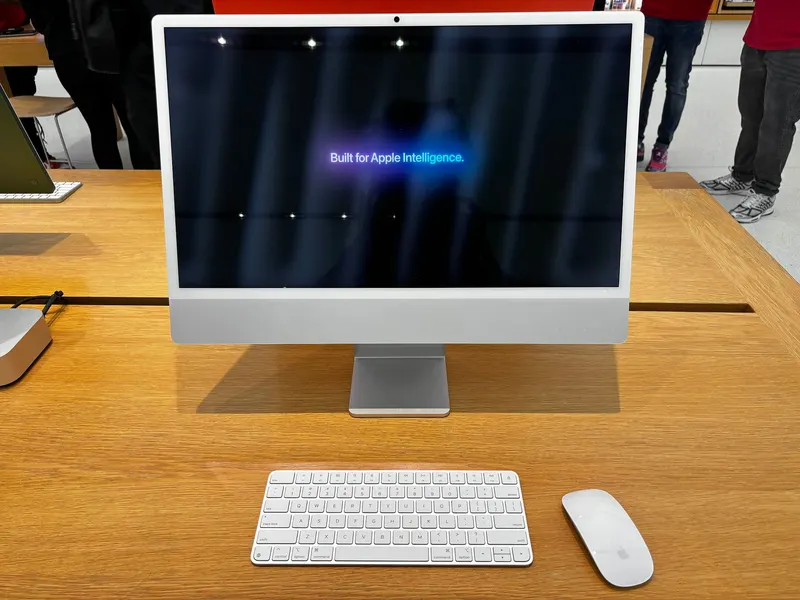
iMac with M6
The 24-inch iMac with a 4.5K screen at 500 nits, in seven colours, from $1,499 with a 10-core CPU and 10-core GPU or from $1,699 with 12 and 12. The 12-core models have up to four Thunderbolt 4 ports, and every model gets Wi-Fi 7 and Bluetooth 6.
MacBook Pro with PROLED XDR Display
A separate product with different chips: M5 Pro or M5 Max, up to 128 GB of unified memory and up to 16 TB of storage. The tandem OLED screen reaches up to 2,000 nits peak brightness in HDR and SDR, refreshes at up to 120 Hz and as low as 10 Hz, and takes touch. The 14-inch starts at $2,899 with M5 Pro and $4,499 with M5 Max; the 16-inch at $3,399 and $4,799.
iPad mini with A20 Pro
An 8.5-inch OLED screen, a 2-nanometre A20 Pro, IP67 water resistance and 5.4 mm thin, from $699 for Wi-Fi and $849 with cellular.
For AI at home, look at memory
On a Mac, the size of the model you can run is set by unified memory, and how fast it answers by memory bandwidth. The M6 models stop at 32 GB, which fits small and mid-size models. The PROLED MacBook Pro goes to 128 GB, enough for far larger ones. Our AI tool reads each Mac's memory and bandwidth and tells you what fits. Every speed figure above is Apple's own.