
Lean and Mathlib certify the Riemann hypothesis proof written with Claude
Their joint statement says the 17 million lines of Lean prove the real theorem. Mathematicians say understanding the proof is the work that starts now.
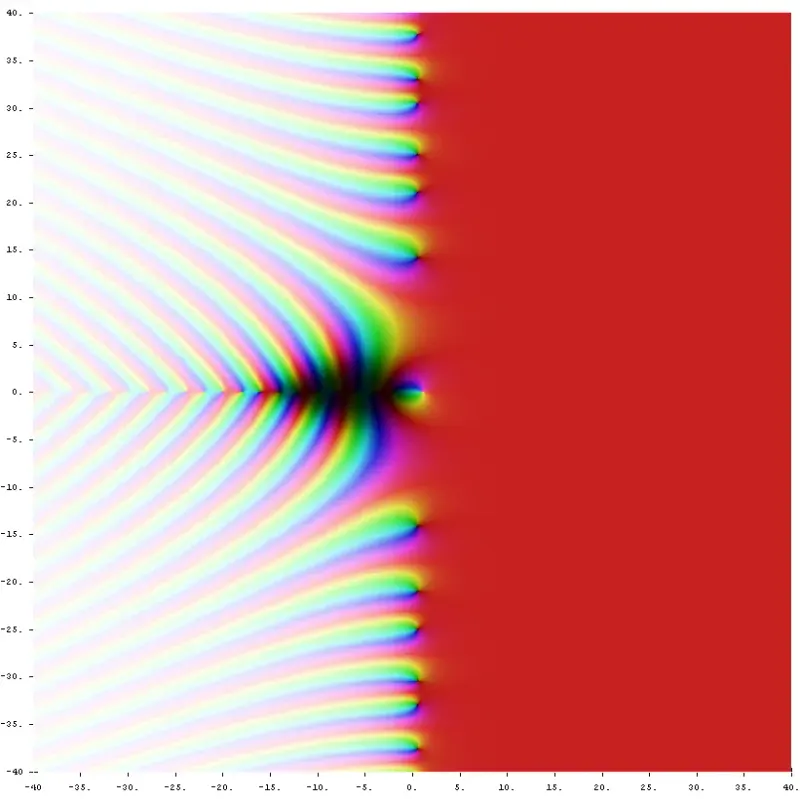
Jan Homann, public domain, Wikimedia Commons
On Saturday, November 21, the Lean and Mathlib communities put out a joint statement certifying the proof of the Riemann hypothesis that Levent Alpöge, a mathematician at Anthropic, produced with Anthropic's Claude and posted the day before as 17 million lines of Lean code. "We hereby certify that both the statement and the proof of the Riemann Hypothesis are correct," it says. "We have full confidence that Alpöge's proof of the Riemann Hypothesis is correct, and we congratulate him on this achievement." It is endorsed by the Lean FRO and the Mathlib Initiative, the groups behind the language and its library of mathematics, and carries no individual signatures.
The statement answers four questions that Kevin Buzzard of Imperial College London set out on November 12 for any proof that comes as Lean code: whether the theorem is the real one, whether the code compiles, whether it proves that theorem as stated, and whether the result would stand even if Lean's own kernel had a bug. The theorem uses Mathlib's own statement of the hypothesis, which "has been carefully vetted by experts in Lean and number theory," and two separate tools found that Alpöge's version matches it exactly. Dozens of people compiled the code and got the same proof file. That file then went through Lean's kernel and several other checkers written in different programming languages, two of which, con-leche and con-ron, come with a formal proof that they cannot accept a false proof. The checks ran on a data-only export of the proof, so no code hidden in its sources could run.
What is still running
Andrew Sutherland of MIT has been checking the proof on his own machines and lists every result on a public page. By Sunday afternoon (UTC), all 175,187 modules had compiled with no errors, the proof used only Lean's three standard axioms, and the checkers nanoda, con-leche, con-ron and lean4lean had each accepted it. Two of the longest runs were still going: the official comparator's kernel stage on the 61.6 GB export, single-threaded since Friday evening, and a second pass of Lean's own kernel over the same export.
The page also spells out what was proved: the hypothesis for the zeta function, and the generalized version for all Dirichlet L-functions. The wider families of L-functions that mathematicians also study "are not among the statements that were checked." Sutherland has since combined the proof with an existing Lean library to derive Robin's inequality, a statement about sums of divisors known to be equivalent to the hypothesis, and that combined proof compiles too.
Correct is not the same as understood
The certification says the proof holds, not why. "At the minute, we don't even know why the theorem is true," Buzzard told Al Jazeera, adding that once experts have Lean code in hand, they usually understand it much better "within a week or two." The statement itself ends: "We look forward to all the activity in the mathematical community that will help explain the new ideas in this proof."
Mathematicians are split on what it means. "If this fully checks out, it is clearly a historic milestone in mathematics," James Maynard of Oxford told Nature. Tristan Buckmaster of NYU, who worked with Alpöge on a separate result, said: "At the moment, it apparently is crazily complicated. It's going to take a long time for mathematicians to digest." The Association for Human Mathematics said that "at this time, no human being can reasonably claim to be responsible for, or even to understand, such a document."
Anthropic has made no announcement about the proof. The Clay Mathematics Institute's $1 million prize is awarded only once a solution has been published, two years have passed and mathematicians generally accept it, and the institute has said nothing about this one.
Sources
- Lean community blog: Lean verification of the Riemann Hypothesis (November 21, 2026)leanprover-community.github.io
- Andrew Sutherland (MIT): verification resultsmath.mit.edu
- Xena: And the proof is checked in Lean (November 12, 2026)xenaproject.wordpress.com
- Levent Alpöge: remark (PDF)alpo.ge
- Association for Human Mathematics: statementsahmath.org
- Clay Mathematics Institute: rules for the Millennium Prize Problemsclaymath.org
- Al Jazeera: Riemann hypothesis: has the world's most famous maths problem been cracked? (November 21, 2026)aljazeera.com
- Nature: news on the Lean proof of the Riemann hypothesisnature.com