
NASA locks in design for SR-1 Freedom, its 2028 nuclear-powered spacecraft carrying three helicopters to Mars
Revised plans call for a shorter reactor boom, larger X-band dishes and a $39.3 million heat-rejection system from Johns Hopkins APL ahead of NASA’s first fission flight beyond Earth orbit.
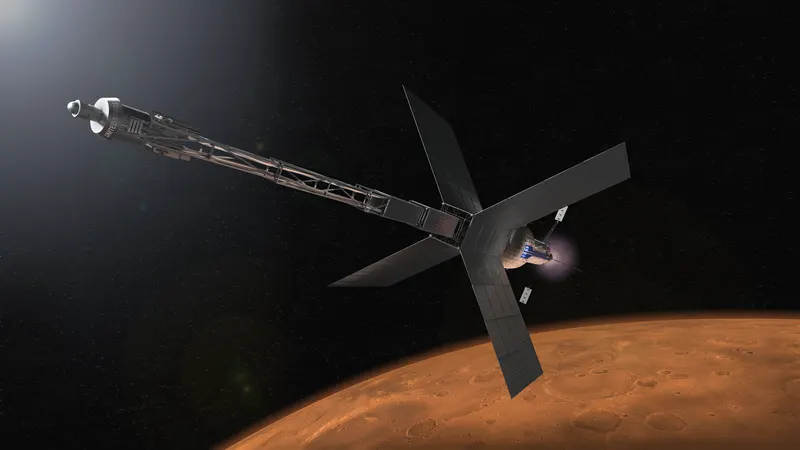
NASA, public domain, Wikimedia Commons
NASA has completed a major design review for Space Reactor-1 (SR-1) Freedom and signed off on the spacecraft’s core architecture ahead of a planned launch in late 2028, the agency announced on Tuesday, November 24. SR-1 Freedom is set to be the first fission-powered spacecraft to fly beyond Earth orbit. It will test nuclear electric propulsion in deep space while carrying SkyFall, a capsule packed with three next-generation Mars helicopters.
Engineers from NASA, the U.S. Department of Energy and industry partners met in October at NASA’s Glenn Research Center in Cleveland to finalize the layout. “This mission will be the first freight run on the railroad of the solar system, and the decisions we’re making now are laying the tracks for every nuclear-powered spacecraft that follows,” said Steve Sinacore, SR-1 Freedom program director.
Design revisions and a $39.3 million cooling contract
Since NASA Administrator Jared Isaacman introduced the concept in March at the agency’s Ignition event, engineers have shortened the boom separating the reactor from the spacecraft’s Power and Propulsion Element to cut mass and simplify assembly. Upgraded radiation shielding lets the reactor sit closer to the spacecraft body while still protecting onboard electronics and the SkyFall payload. The module is also getting larger X-band antenna dishes for deep-space communications. Engineers are still working out the final radiator panel count, nuclear power module output levels and operating duration.
To handle waste heat from the reactor, NASA awarded a $39.3 million contract to Johns Hopkins University’s Applied Physics Laboratory to build and test the flight heat-rejection system, with Advanced Cooling Technologies supplying heat pipes and composite radiators. In October, NASA tapped Sierra Lobo to supply the closed Brayton cycle power-conversion system, which turns heat from the Department of Energy’s Idaho National Laboratory fission reactor into electricity.
Nuclear at both ends, solar in the middle
The fission reactor will stay shut down during launch and activate only after SR-1 Freedom leaves Earth orbit. It will then ramp up for an initial operating period to send performance data back to Earth before powering down so solar arrays can handle the cruise to Mars.
Once in Martian orbit, the spacecraft will release SkyFall so its three Ingenuity-derived helicopters can study Martian geology and climate history, explore new terrain and search for signs of subsurface ice. After deploying the capsule, SR-1 Freedom will restart its reactor for another round of deep-space tests. NASA expects the work to feed directly into fission surface power systems for its planned Moon Base.