
An Anthropic mathematician says he proved the Riemann hypothesis with Claude, and the first checks of his Lean proof hold up
Levent Alpöge posted the proof on Friday as computer-checked code only, with no paper. Two independently written proof checkers have accepted all of it, and two more runs are still going. A human mathematician's claimed proof of the generalized hypothesis, which nobody has verified yet, appeared the same day.
Smithsonian Institution, no known copyright restrictions, Wikimedia Commons
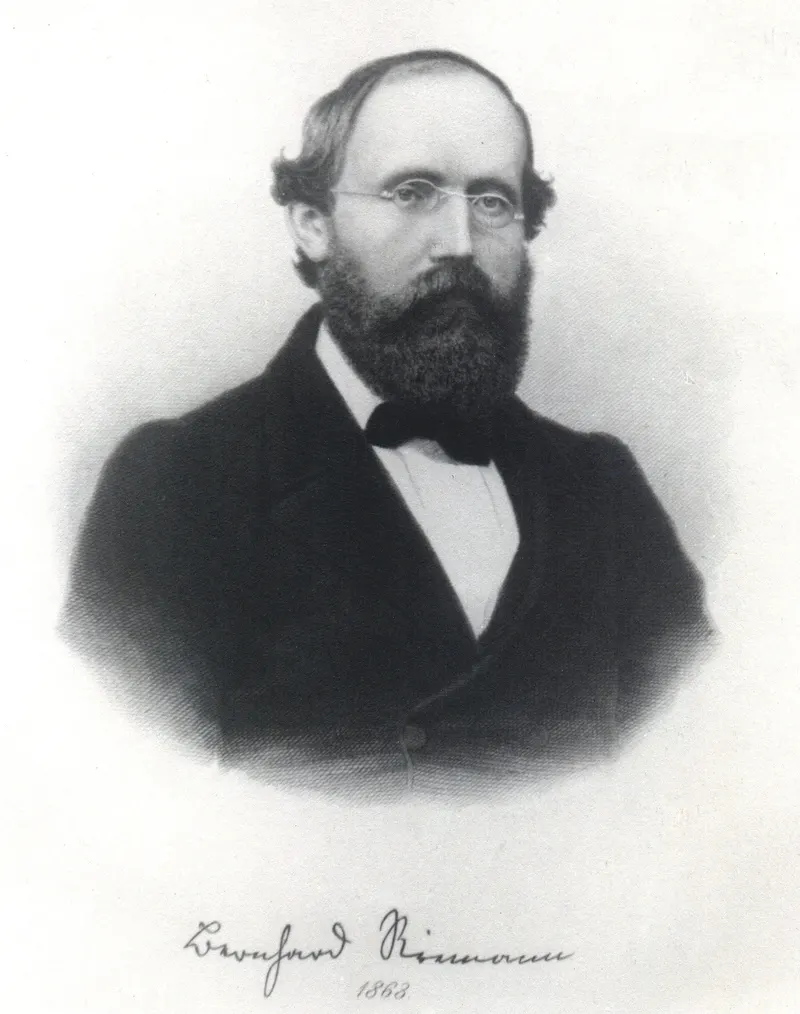
Levent Alpöge, a mathematician at Anthropic, said on Friday, November 20, that he believes he has proved the Riemann hypothesis with Claude, the company's AI model. The hypothesis, posed by Bernhard Riemann in 1859, says that every non-trivial zero of the zeta function lies on a single line, the one where the real part is ½. Where those zeros lie governs how regularly the prime numbers are spread out. It has stood for 167 years and is one of the seven Millennium Prize Problems the Clay Mathematics Institute set in 2000, each with a $1 million prize. Alpöge says the same method also settles the generalized Riemann hypothesis, the same statement for a wider family of functions, and his Lean files prove it for all Dirichlet L-functions.

He posted no paper. The proof comes only as code, in 14 downloadable parts, written in Lean, a programming language in which a computer checks every step of a proof. "It being obviously inappropriate to attempt to post some massive unreadable travesty of 'slop', I decided to only present Lean," he wrote in a four-page note. A write-up Claude produced along the way ran to more than 250,000 pages. He calls the argument "incredibly long at the moment," expects it to be simplified, and says he will work to understand it and write it up properly.
Terence Tao, a Fields Medal winner at UCLA, called it an "enormous" Lean-only proof on his blog the same day. Its strategy, he wrote, "from very initial analysis, appears to use the full power of modern developments on the Langlands program and arithmetic geometry."
Alpöge also put out, with Tristan Buckmaster of NYU, a proof, formalized in Lean, that solutions of the three-dimensional Navier–Stokes equations, which describe how liquids and gases flow, can blow up in finite time even with no outside force acting on the fluid.
What has been checked
Andrew Sutherland of MIT and other mathematicians compiled the code independently within hours. "The Lean proof has been compiled and independently rechecked by the Lean kernel with only the three standard axioms," Sutherland told Scientific American. "Honestly the chance that anything is fishy here is approximately zero."
By Saturday morning, Sutherland's results page showed all 175,187 modules of the proof compiling without errors. Two independently written proof checkers, nanoda and con-leche, had accepted the whole exported proof, and an independent version of the official comparator's check had matched its five main theorems to the statements they set out to prove. Two runs were still going: the official comparator itself, which had already passed its comparison of the statements and its axiom check and was working through its kernel stages, and a second pass of Lean's own kernel over the exported proof.
Kevin Buzzard of Imperial College London has said the comparator is what confirms that the code doesn't quietly redefine any symbol in the theorem's statement and, run in its strictest mode, that the proof holds up under several independent kernels. The first question for any proof that comes with Lean code, he wrote, is "what is the statement of the theorem in the Lean code, and does this correspond to the actual theorem statement."
A human claim the same day
Hours later Ravi Vakil, a Stanford professor and president of the American Mathematical Society, posted a claimed proof of the generalized Riemann hypothesis by Alessandro Masullo, who says it is the result of 12 years of work. "It is all human, with no AI," Vakil wrote, adding that the plan had been to bring Masullo to Stanford for a year to polish it and run it by enough people before announcing it. It has not been written in Lean, nobody has verified it yet, and Brian Conrad, the Stanford mathematician who has been giving Masullo feedback, told Scientific American that "it's undergoing major revision." Masullo's introduction speaks to "the mathematician who feels discouraged by the pace and tone of the current climate": "We are still here. We are very much alive. We are not going anywhere."
The timing and the prize
Alpöge's post came in the same week Anthropic listed its shares on the Nasdaq. "The precise timing is horrible," he wrote. He says it "all happened for me late Sunday night," and that he messaged chief executive Dario Amodei, eventually asking whether he could announce it. "There is an obvious cynical view, to do with the timing, but it is false."
Under the Clay Institute's rules, a solution is considered only once it has appeared in a qualifying publication, at least two years have passed, and mathematicians generally accept it.
Sources
- Levent Alpöge: note announcing the proof (PDF), November 20, 2026alpo.ge
- Andrew Sutherland (MIT): RH Lean proof, verification filesmath.mit.edu
- Scientific American: The AI Riemann hypothesis proof is almost certainly true, independent mathematicians attestscientificamerican.com
- Scientific American: Dueling claims of Riemann hypothesis proofs emergescientificamerican.com
- TechCrunch: AI claimed a solution to the 167-year-old Riemann hypothesis, and a human did, tootechcrunch.com
- Terence Tao: Unforced Euler singularity, unforced Navier-Stokes singularity, and the Generalized Riemann Hypothesisterrytao.wordpress.com
- Clay Mathematics Institute: The Millennium Prize Problemsclaymath.org
- Clay Mathematics Institute: Rules for the Millennium Prizesclaymath.org