
BepiColombo is in orbit around Mercury after eight years in space, with two orbiters on board
It is only the second spacecraft to orbit Mercury, after NASA's MESSENGER. Europe's MPO and Japan's Mio part ways in December, and science starts in April.
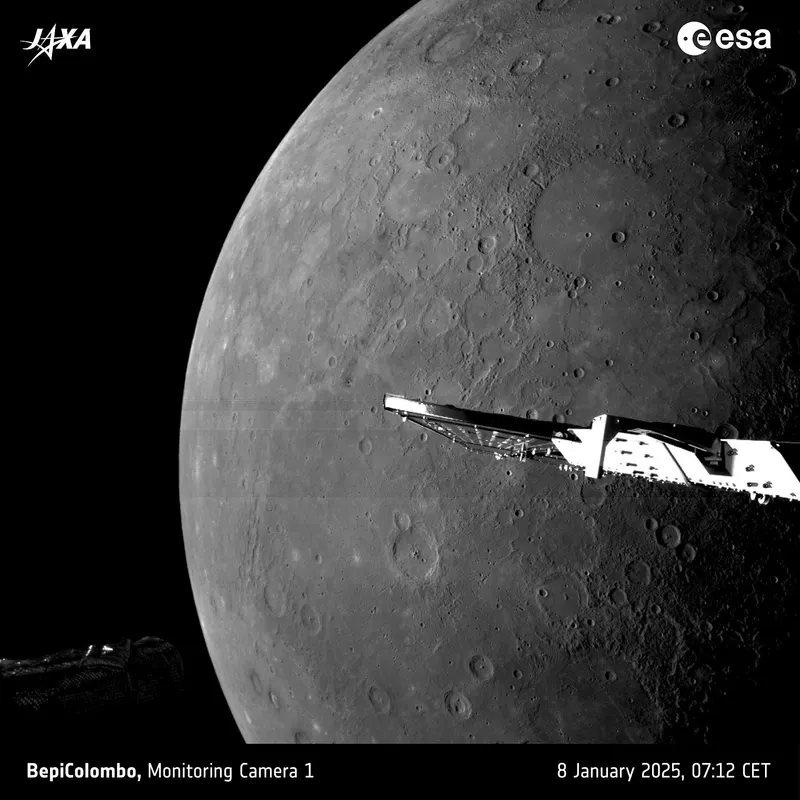
ESA/BepiColombo/MTM, CC BY-SA 3.0 IGO, Wikimedia Commons
BepiColombo, the Mercury mission built by the European Space Agency (ESA) and Japan's JAXA, went into orbit around the planet on Saturday, November 21, eight years after it left Earth. Its four thrusters fired for 37 minutes from 18:24 UTC as it came in over Mercury's night side, and hours later ESA's operations center in Darmstadt, Germany, heard back. "Flight Dynamics already has confirmed it achieved orbital capture around Mercury!" ESA's operations team posted on X. It is only the second spacecraft to orbit Mercury, after NASA's MESSENGER, and the first to bring two orbiters.
The two are Europe's Mercury Planetary Orbiter (MPO) and Japan's Mio, which have flown stacked together under a sunshield since an Ariane 5 launched them on October 20, 2018. The stack is starting out in an elliptical orbit of about 590 by 11,640 km. On December 9 and 10, MPO lets Mio go into its own polar orbit; MPO drops the sunshield on December 16 and lowers itself to an orbit of 480 by 1,500 km by March 10. Science begins on April 6, 2027. ESA and JAXA hold a briefing on Friday, November 27.
Harder than Pluto
"Reaching Mercury is actually harder than reaching Pluto," ESA's Azul Pinochet-Barros said in September. "The challenge isn't getting closer to the Sun. It's losing enough energy to match Mercury's path around the Sun." BepiColombo shed that energy with nine flybys, one of Earth, two of Venus and six of Mercury, over a trip of about 9.9 billion km.
It arrived a year late. On April 26, 2024, the transfer module that carried the stack "failed to deliver enough electrical power to the spacecraft's thrusters," ESA said, and full thrust could not be restored. The route was redrawn, and arrival moved from December 2025 to November 2026. The transfer module separated on September 3 this year.
One instrument is already at work. MIXS, an X-ray telescope on MPO built with the University of Leicester, picked up the Crab Nebula, 6,500 light-years away, during 39 hours of tests on September 11 and 12, with slightly sharper images than in its lab tests in 2015. "This first data is mind-blowing to me," said Adrian Martindale, the instrument's scientist.
Sources
- ESA: BepiColombo arrival at Mercury timelineesa.int
- ESA: BepiColombo entering orbit around Mercury (November 19, 2026)esa.int
- ESA: Glitch on BepiColombo, work ongoing to restore spacecraft to full thrustesa.int
- ESA: BepiColombo begins Mercury arrival with MTM separation success (September 3, 2026)esa.int
- JAXA ISAS: BepiColombo's revised arrival (September 3, 2024)isas.jaxa.jp
- Eos: BepiColombo arrives at Mercuryeos.org
- AFP via The Manila Times: Japan-Europe joint probe enters Mercury's orbit (November 22, 2026)manilatimes.net
- ScienceDaily (University of Leicester): MIXS first observations (November 20, 2026)sciencedaily.com
- ESA: media briefing on BepiColombo's arrival at Mercury (November 27, 2026)esa.int