
NASA pauses science on Perseverance and Mars Odyssey after a radio fault and a stopped reaction wheel
The rover is talking to Earth directly at a much lower data rate, so it has stopped taking pictures. Without a working wheel, Odyssey has fuel to keep itself pointed for one to two months.
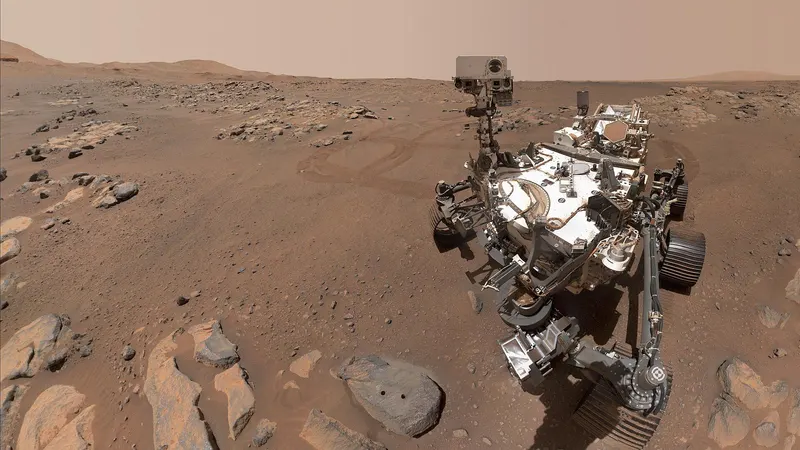
NASA/JPL-Caltech/MSSS, public domain, Wikimedia Commons
NASA has paused science on two of its Mars missions while engineers work on separate faults, the agency said on Thursday, November 19. The Perseverance rover is stable and in contact with its team, which hopes it can return to science by the end of November. The Mars Odyssey orbiter is out of safe mode, but its instruments stay off while one of its reaction wheels is tested.
Perseverance: both radios
On October 30, when the rover powered on for the day, its main UHF radio, the one it uses to send large amounts of data to orbiters for relay to Earth, didn't send the regular "heartbeat" signals the rover's main computer listens for. After 25 missed heartbeats, about 100 seconds of silence, the computer switched the radio off, moved to the backup and put the rover into safe mode. Once the rover was out of safe mode, engineers found the backup radio sending at about half its expected power. They have stopped using both until they know why.
"The rover's main computer continually listens for that ping," said Steven Lee, Perseverance's project manager at NASA's Jet Propulsion Laboratory. "Every time it hears the ping, it resets a counter. However, if the radio stops sending the heartbeat due to a fault, after a certain number of missing heartbeats in a row, the computer swaps to the redundant one."
For now Perseverance talks to NASA's Deep Space Network directly through its high-gain antenna, at a much lower data rate. Science and instruments are paused to keep that link for diagnostic data, and the rover isn't taking new pictures; no new raw images have been posted since November 7. Less than three weeks before the fault, on October 11, Perseverance had passed Opportunity's record for the farthest total distance driven on another world, 28.06 miles (45.16 km).
Odyssey: one wheel short
Odyssey, in orbit around Mars since October 2001, was in safe mode from November 4 to 6. Engineers found that one of its reaction wheels, which turn the spacecraft by speeding up and slowing down, had stopped spinning. It has four, one of which failed in 2013, and it needs three to stay oriented. Without them it would have to point itself with its hydrazine thrusters alone, and after 25 years at Mars it has enough fuel for that for only one to two months.
In one test the wheel moved when commanded, and further tests will show whether it can be recovered. NASA aims to have Odyssey back on science and relaying data from the surface in the last week of November. Built for a mission of just over two and a half years, Odyssey has worked around Mars longer than any other spacecraft, and it relayed the first pictures after landing from Phoenix, Spirit, Opportunity and Curiosity.