
Voyager 1 is now one light-day from Earth, 49 years after launch
Light, and any radio signal, now needs a full day to reach it. It crossed that line at 10:16 UTC on November 18, about 25.9 billion kilometres out.
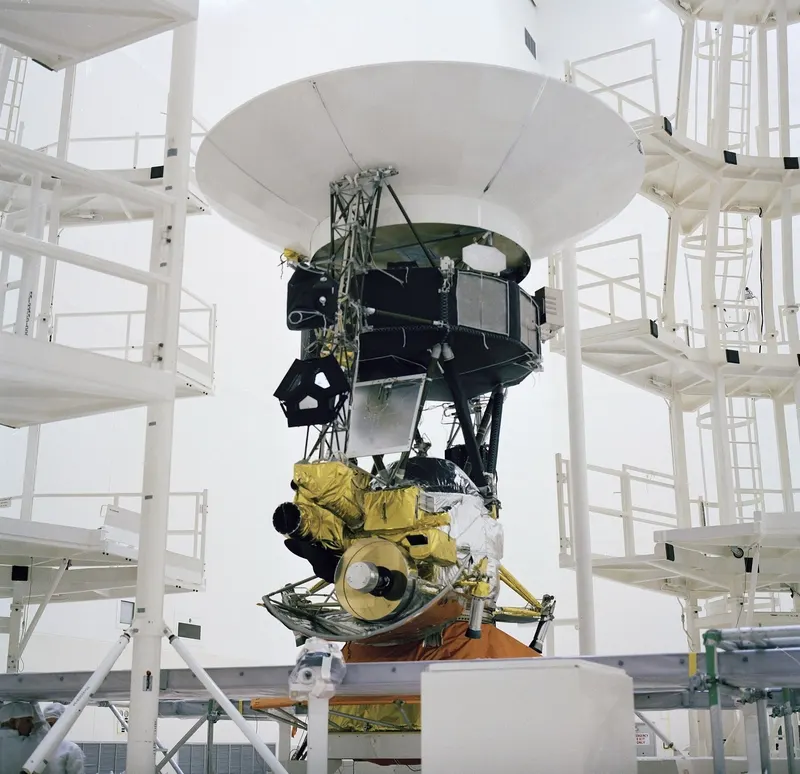
NASA/JPL, public domain, Wikimedia Commons
NASA's Voyager 1 passed one light-day from Earth at 10:16 UTC on Wednesday, November 18. That is the distance light covers in 24 hours: 25,902,068,356 kilometres, or 16,094,799,096 miles. No spacecraft has been that far from Earth before.

It took 49 years, two months and 11 days to get there after launching on September 5, 1977. A command radioed from Earth now needs a full day to reach it, and its reply another day to come back.
Still moving out
Voyager 1 is travelling at nearly 61,000 km/h (38,000 mph) and left the planets behind long ago. In August 2012 it became the first spacecraft to enter interstellar space. Its twin, Voyager 2, launched two weeks earlier on a different path and should be one light-day away in November 2035.
Its course points towards AC +79 3888, also known as Gliese 445, a star more than 17 light-years away. In about 40,000 years Voyager 1 will pass within roughly 1.7 light-years of it.
Two instruments left
Of the ten science instruments it launched with, two still work. Its power comes from a radioisotope generator whose output drops every year, so the team has been switching instruments off one at a time; the low-energy charged particle instrument went off in April.
Sources
- NASA: Voyager 1: What Is a Light-Dayscience.nasa.gov
- NASA SVS: How Far Away Is Voyager 1? One Light-Day, Explainedsvs.gsfc.nasa.gov
- Popular Science: Voyager 1 is almost one light-day away from Earthpopsci.com