
Webb watched two stars merge in the Andromeda galaxy, 47 days after the eruption peaked
A supergiant seven times the Sun's mass swallowed a smaller companion after only about seven orbits. No merger like it has been followed up this early.
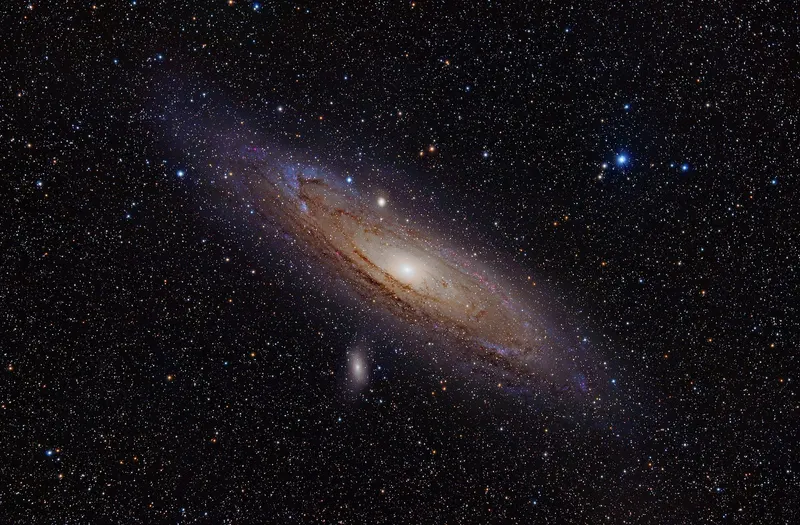
Adam Evans, CC BY 2.0, Wikimedia Commons
Astronomers have watched two stars become one in the Andromeda galaxy, and NASA's James Webb Space Telescope looked at the aftermath only 47 days after the eruption peaked. The event, AT 2025abao, nicknamed Bao, is described in a paper published in Nature on Wednesday, November 18.

The larger star, Big Bao, was a puffy supergiant about seven times the Sun's mass, 350 times its radius and 18,000 times as bright. Its companion, Little Bao, had about 0.7 times the Sun's mass. They merged after only about seven orbits, roughly seven years; the mergers of smaller stars seen before took thousands of orbits.
Caught as it happened
NASA's NEOWISE mission first flagged the star in 2023. Over the next two years it brightened and wrapped itself in dust, and in October 2025 it erupted. Webb's mid-infrared look in December showed the dust the big star had shed, and NASA says its data proved the two stars merged into one.
“Stellar mergers are very, very difficult to observe in real time because they are hard to predict,” said Viraj Karambelkar, a NASA Hubble Fellow at Columbia University and the paper's first author. He calls Webb's observation “the earliest ever follow-up of an event like this”.
More to come
Not every pair of stars caught in a shared envelope like this merges. Some survive in tight orbits and later become neutron stars or black holes, explode as supernovae or send out gravitational waves. Karambelkar expects plenty more: “There's going to be a large influx of similar discoveries just ahead.”